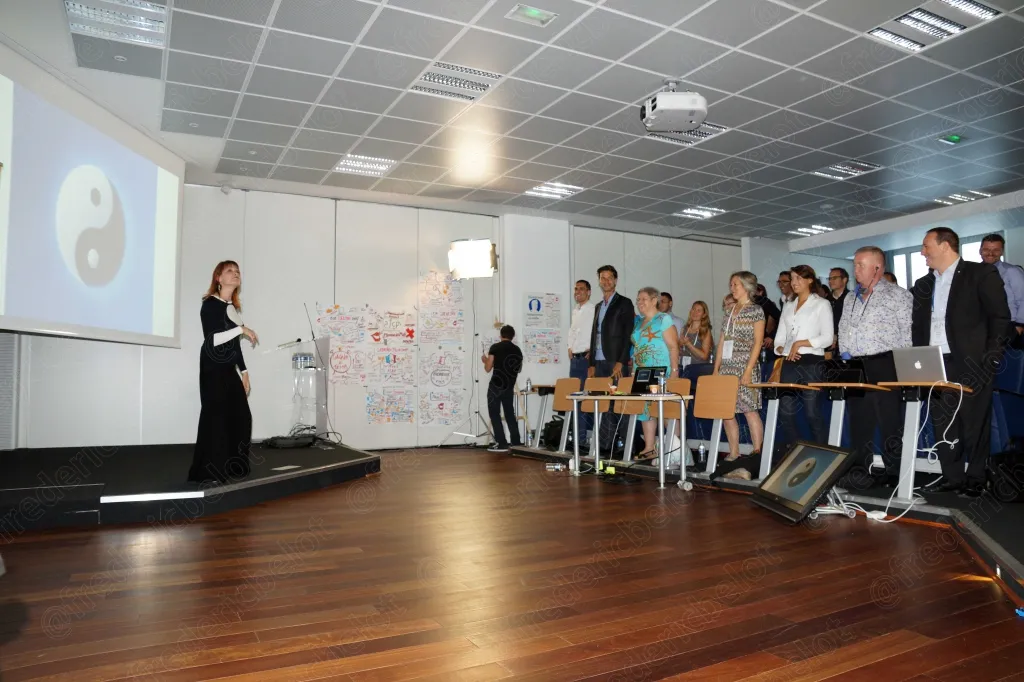
Being the Photographer at a Conference or Corporate Seminar
Covering a conference or a corporate seminar has nothing in common with street photography: the programme is known in advance, the venue is accessible before the event, and the photographer has to produce images that will later be used for communication — website, social media, annual report. That constraint completely changes how you prepare for and cover the day.
Scouting comes first
Arriving on site before the event starts to scout the room changes everything: where the light will be during the talks, which angles let you frame the speaker with the event logo in the background, where to stand so you disturb neither the audience nor the official video crew. Those few minutes of scouting save you from improvising mid-talk, at the very moment when you can no longer afford to hunt for a position.
Stay discreet during the talks
While a speaker is on stage, the photographer needs to fade into the background: no flash, slow and infrequent movements, a silent shutter if possible. The goal is to capture the energy of the talk — a gesture, an expression, the audience’s attention — without ever becoming a visible distraction from the stage or the front rows.
Don’t limit yourself to the stage
The most useful photos aren’t always the ones of the speaker at the microphone. Audience faces reacting, conversations during coffee breaks, small-group workshops, the in-between moments — someone laughing, a handshake, a moment of concentration over a notebook — tell the story of the event’s atmosphere far better than a string of identical shots of whoever happens to be speaking. I always set aside part of the available time to move around away from the stage, precisely to capture those moments.
Portraits, handled separately
If individual portraits of participants or speakers are planned, it’s better to treat them as a mini-session in their own right: a dedicated corner with consistent light and background, rather than trying to grab them at random in the flow of the event. The result is far more usable afterwards, and the participant doesn’t feel caught off guard in a pose they never chose.
Deliver fast, deliver well curated
A corporate client often needs a few photos very quickly — for a story or a post published that same evening — ahead of the full set. Planning for that quick selection right from the shoot, keeping in mind which images will be the most immediately usable, saves precious time when it comes to delivery.